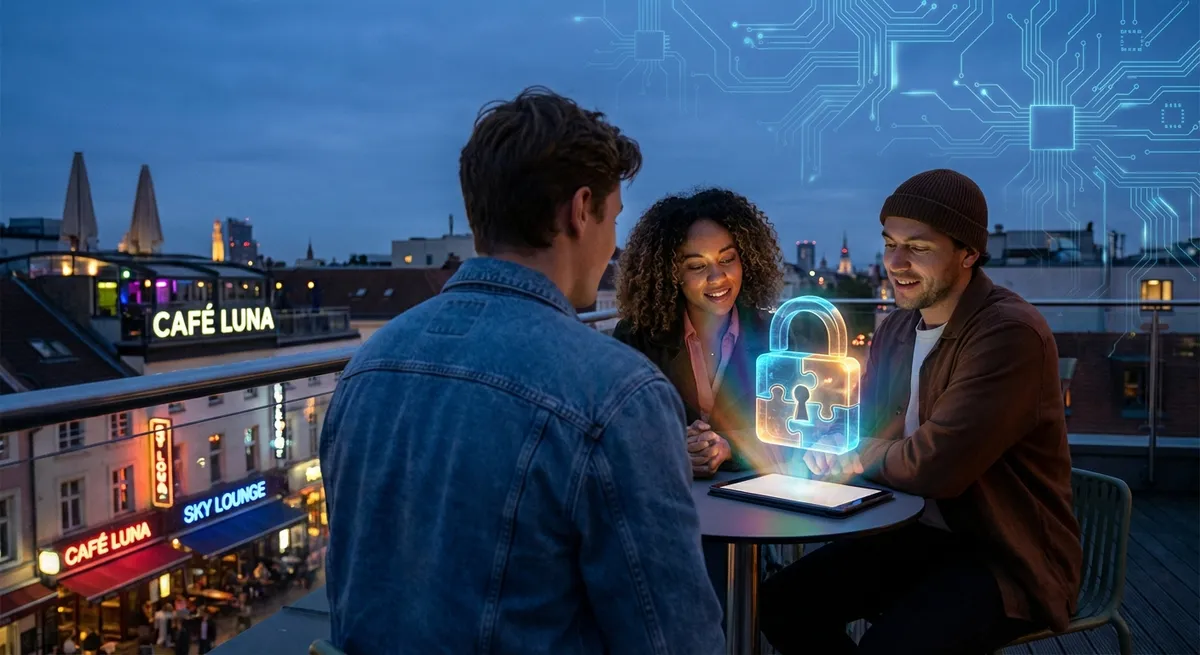
Let’s unpack where cybersecurity is really heading—beyond the fear, beyond the jargon—and why the human layer is about to matter more than any piece of hardware in your stack.
From “Blame the User” to Designing for Real Humans
For years, people were labeled “the weakest link.” Clicked a bad link? Your fault. Reused a password? Your fault. But that mindset is quietly dying, and that’s a good thing.
We’re shifting toward human-centered security, where systems are designed to work with people instead of against them:
- Security built into workflows, not bolted on
Instead of asking employees to jump through 14 security hoops, modern tools try to sit in the background—auto-filling strong passwords, spotting suspicious logins, and flagging risky behavior without nagging every 5 minutes.
- Behavior-aware defenses
Emerging platforms analyze how you usually work—what devices you use, when you typically log in, which files you access. If something looks wildly off (sudden late-night logins from another country, mass file downloads), the system steps in even if your password was correct.
- Security UX as a competitive advantage
Companies are realizing that security interfaces that confuse people are, bluntly, insecure. Expect to see more plain-language warnings (“This link is likely a phishing scam”) instead of obscure error codes or legalese.
Underneath it all is one quiet but radical idea: if you design systems that respect human limits and habits, you don’t have to rely on superhuman users to stay safe.
AI Versus AI: Defending Against Machine-Made Attacks
AI isn’t just a defensive tool—attackers are using it too, and they’re getting better at it.
We’re entering an era of AI-versus-AI cybersecurity, where both sides are automating, adapting, and learning in real time.
On the attacker side:
- Hyper-personalized phishing
AI can scrape social media, public records, and leaked data to craft eerily convincing messages that sound like your boss, your bank, or your favorite brand. No more broken English or weird threats—just tailored persuasion.
- Deepfake-enabled scams
Voice and video deepfakes can now mimic executives, family members, or support staff well enough to trick people into authorizing payments or sharing sensitive data.
- Automated vulnerability discovery
Machine learning models can scan code, websites, and cloud setups at scale, spotting weak points much faster than a human attacker ever could.
On the defender side:
- Anomaly detection at scale
AI now monitors millions of events (logins, file edits, API requests) and learns what “normal” looks like. When something drifts from that pattern—subtly or dramatically—it can trigger an immediate response.
- Adaptive access control
Instead of simple “password OK = access granted,” AI-driven systems weigh multiple signals: device reputation, location, behavior patterns, recent activity. Access becomes a sliding scale, not an on/off switch.
- Automated triage and response
Security teams are drowning in alerts. AI is increasingly used to prioritize which ones matter, correlate related events, and in some cases automatically isolate devices or accounts before humans ever log in.
The tension here is obvious: the same technologies powering personalized shopping, instant recommendations, and chatbots are also powering the next generation of cybercrime. The winners will be the organizations that treat AI not as magic, but as a tool that demands governance, transparency, and constant tuning.
Passwords Are Fading: The Rise of Invisible Authentication
If you’re exhausted by passwords, you’re not alone. The industry is, too.
We’re moving from “something you know” (passwords) to “something you are and do” (behavior, biometrics, and device trust). The shift is subtle but game-changing.
Key emerging trends:
Passkeys and passwordless logins
Instead of memorizing strings of characters, passkeys use cryptographic keys stored on your device—often protected by biometrics like Face ID or a fingerprint. Even if an attacker steals a database, they can’t simply “reuse” your password.
Continuous authentication
Rather than proving your identity once and getting a free pass, systems are starting to continuously reassess: - Are you typing like you usually do? - Are you accessing data consistent with your role? - Is your network environment suddenly different? If signals change dramatically, the system can ask for extra verification or cut access entirely.
Behavioral biometrics
It’s not just about your fingerprint. It’s how you scroll, swipe, type, and move. Emerging tools build a behavioral profile over time so that even if someone steals your device, they still don’t “move” like you.
Device and context as security signals
A login from your usual laptop, at home, during office hours, might be approved instantly. The same login attempt from a new device in a different country might trigger extra checks.
We’re heading toward a future where the most secure experiences are also the smoothest ones—and where the password field slowly disappears from everyday life.
Cyber-Physical Security: When Hacks Spill Into the Real World
Cybersecurity is no longer just about files and servers. It’s about cars, hospitals, power grids, factories, and even your thermostat.
That merging of digital and physical is creating cyber-physical risk—and it’s forcing security thinking to evolve fast.
Why this matters:
- Connected everything = bigger attack surface
Industrial control systems, smart buildings, medical devices, and vehicles are all increasingly online. Many were never designed with modern cybersecurity in mind.
- Real-world consequences
Ransomware that locks a corporate network is bad. Ransomware that disrupts fuel pipelines, hospital systems, or emergency services moves cybersecurity into the realm of public safety and national security.
- Regulation is catching up—slowly
Governments are starting to push for minimum cybersecurity standards in critical sectors and connected devices. Expect more mandatory reporting, security-by-design requirements, and sector-specific rules.
- Security teams and engineers must collaborate
OT (operational technology) and IT used to live in different worlds. Now they share risk. Defending a factory or hospital isn’t just about patching servers—it’s about understanding physical processes, safety constraints, and uptime requirements.
The takeaway: cybersecurity is becoming as fundamental to physical infrastructure as locks, cameras, or fire alarms. If something can be connected, it can be attacked—and it has to be secured accordingly.
Data, Privacy, and Trust: Security as a Brand Decision
Security isn’t just a technical problem; it’s rapidly becoming a trust and reputation problem.
Users are more privacy-aware than ever, regulators are more active, and the cost of losing trust can dwarf the cost of any single breach.
Emerging trends shaping this space:
- Privacy by design, not by apology
The old model—collect everything now, figure out how to protect it later—is under heavy pressure. Leading organizations are rethinking what data they collect, how long they keep it, and who can actually touch it.
- Zero trust—but for data
- Who truly needs access to this dataset?
- Can we limit what they see by default?
- Can we encrypt or anonymize data so even insiders can’t misuse it easily?
- Regulation as a forcing function
Zero trust is usually discussed in terms of networks and devices, but we’re seeing it applied to data:
Laws like the EU’s GDPR, California’s CCPA, and emerging regulations in other regions are pushing companies toward better data handling. Non-compliance is no longer a slap on the wrist—it’s potentially business-threatening.
- Security transparency as a selling point
Clear explanations of how data is used, strong security practices, and fast, honest incident responses are gradually becoming differentiators in the market. “We take your security seriously” is no longer enough; users want proof.
In an AI-driven world, where data is the raw material, organizations that treat data protection as a core value—not just a legal checkbox—will be the ones people stick with.
Conclusion
Cybersecurity is no longer just an IT department problem or a “nice to have.” It sits at the intersection of human behavior, AI, physical safety, brand trust, and regulation.
The emerging trends and innovations to keep on your radar:
- Systems designed for real humans, not idealized “perfect users.”
- AI deployed on both sides—attacks and defenses locked in a constant race.
- Passwordless, continuous, and context-aware authentication quietly replacing old logins.
- Cyber-physical risks turning cybersecurity into a public safety issue.
- Data protection and privacy evolving into a strategic trust decision, not a compliance footnote.
The organizations that thrive in this next phase won’t just buy more tools. They’ll rethink how they design systems, how they handle data, how they communicate risk—and, most importantly, how they center the humans at the heart of it all.
Sources
- NIST: Human-Centered Cybersecurity - Overview of research and guidance on designing security systems around human behavior and usability
- Microsoft: The Emerging Era of AI-Powered Cybersecurity - Analysis of how AI is reshaping both cyber defense and attack techniques
- FIDO Alliance: Passkeys Explained - Technical and practical background on passwordless authentication and passkeys
- CISA: Security for Cyber-Physical Systems - Guidance on protecting industrial control systems and cyber-physical infrastructure
- European Commission: Data Protection and GDPR - Official information on EU data protection regulations and their impact on organizations